COMPANY NEWS
Operating Procedures and Maintenance for Air Shower Pass Boxes
An air-shower pass box (also known as an air-shower pass-through or dynamic air-shower transfer unit) is a specialized airlock isolation device for material transfer within cleanroom systems. Unlike standard static pass boxes that lack an airflow function, this unit serves as a dynamic purification transfer device. It integrates high-pressure circulating air showers, multi-stage air filtration, an interlocked dual-door system, and sealed disinfection modules. When transferring small items between areas with different cleanroom classifications, the unit simultaneously removes dust from the surfaces of the materials, prevents airflow exchange between the two zones, maintains stable pressure differentials, and reduces the risk of cross-contamination by particles and microorganisms.
I. Basic Definitions and Industry Positioning
Independent Circulating Air Shower Purification System
An air-shower pass box functions as a dynamic airlock for materials. Installed in the partition walls between cleanrooms and non-cleanroom areas—or between cleanrooms of different cleanliness classes—it is used for the transfer of tools, raw materials, ingredients, samples, consumables, and small packaged items. Its core feature is an integrated, independent circulating air-shower purification system, which uses high-velocity airflow to remove dust from the surfaces of items during transfer. Simultaneously, an interlocking door mechanism prevents direct airflow between the two areas, serving as the primary line of defense against contamination during the movement of materials within a cleanroom facility.
| Equipment Type | Airflow System | Core Function | Applicable Cleanliness Class (ISO 14644-1) | Compliant Scenarios |
| Static Standard Pass Box | No fan, no active blowing; relies solely on room pressure differential for isolation | Physical isolation only; no surface purification of materials | ISO 7 (Class 10,000), ISO 8 (Class 100,000) and lower-risk areas | Material transfer within cleanrooms of the same class; external packaging of materials that have already been thoroughly cleaned |
| Air Shower Pass Box (Dynamic Air Shower Type) | Pre-filter + HEPA high-efficiency filtration + high-pressure circulating wind system; multi-directional high-speed jet air flushing | Isolation + active dust removal + internal self-cleaning | ISO 5 (Class 100), ISO 6 (Class 1,000), ISO 7 and other high-cleanliness sterile areas | High contamination risk scenarios such as aseptic pharmaceutical manufacturing, microelectronics, biological laboratories, and sterile medical devices |
II. Overall Structure and Functions of Components
Air Shower Circulation / Filtration System / Interlock Control System
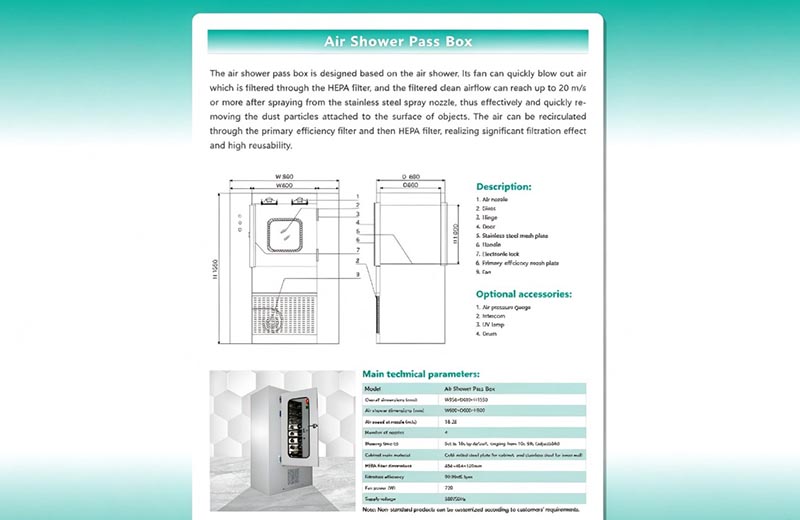
A standard air-shower pass box consists of six major assemblies: the main enclosure, the air-shower circulation system, the filtration system, the interlocking control system, the auxiliary disinfection/sterilization module, and the sealing structure. The entire design adheres to the core principles for cleanroom equipment: "no dead zones, easy to wipe clean, and corrosion-resistant."
Q: Enclosure Structure
A: Cold-rolled steel with electrostatic powder coating: Cost-effective; suitable for electronics manufacturing or general food-drying facilities. SUS304/SUS316L stainless steel: Recommended under GMP standards; features stainless steel interior walls and work surfaces with rounded corners (radius R ≥ 20mm) to eliminate dust-trapping dead zones. Resistant to corrosion from alcohol and hydrogen peroxide disinfectants; 316L stainless steel is mandatory for sterile pharmaceutical production and biological laboratories.
Q: Air-Shower Circulation System (Core De-dusting Unit)
A: High-pressure centrifugal fan: Low-noise, energy-efficient design that provides the necessary circulation pressure to ensure target air velocity at the nozzles. Adjustable stainless steel nozzles: Strategically positioned around the interior walls with 360° adjustability, ensuring comprehensive, all-around air coverage for materials with no cleaning blind spots. Circulation air ducts: Includes a bottom return-air channel equipped with a housing for a primary filter; dislodged dust is carried by the airflow back to the filtration system, creating a closed-loop cycle.
Q: Multi-Stage Filtration System (Cleanliness Assurance)
A: Employs a "coarse filtration upstream, fine filtration downstream" logic, compliant with the ISO 16890 standard for filter media. Primary filter: Located at the return-air inlet to capture large dust particles and fibers, thereby protecting the downstream high-efficiency filter and extending the service life of the HEPA filter. High-efficiency (HEPA) filter: Installed at the outlet of the static pressure plenum; provides ≥99.995% filtration efficiency for 0.3μm particles. All airflow within the unit passes through the HEPA filter, enabling the interior to achieve an ISO 5 (Class 100) cleanliness standard.
Q: Dual-Door Interlock Control System
A: This system is categorized into mechanical and electronic interlocks. Its core function is to ensure that both doors cannot be opened simultaneously, thereby completely blocking direct airflow exchange between clean zones of different cleanliness levels, preventing the loss of positive pressure within clean zones, and avoiding the ingress of external contaminants. Mechanical Interlocks: Utilize purely mechanical linkages and latches; they require no power supply, have a low failure rate, and are suitable for explosion-proof environments or locations without a power source. A limitation is that they cannot automatically time the air-shower process. Electronic Interlocks: Consist of electromagnetic locks and a PLC control panel, equipped with indicator lights and audible alarms (buzzers). When one door is opened, the electromagnetic lock on the opposite door is automatically engaged. Once the doors are closed, the air-shower timer begins; upon completion of the air-shower cycle, the lock on the opposite door is released. The air-shower duration can be customized between 15 and 60 seconds.
Q: Auxiliary Disinfection/Sterilization Modules (Optional Configurations)
A: UV Germicidal Lamps (UVC 254nm): Installed at the top of the chamber, these lamps operate when the unit is idle to eliminate airborne microorganisms and those adhering to surfaces. Standards require an irradiance of ≥70μW/cm² at the center of the lamp. To prevent UV-induced injuries, the power is automatically cut off whenever personnel are present or the air-shower system is in operation. Ozone Disinfection Module: Primarily used in biosafety laboratories or pass-through boxes for highly contaminated waste; it provides broad-spectrum elimination of spores and viruses. Following disinfection, the ozone decomposes during a sealed dwell period, leaving no residue. Differential Pressure Gauge: Monitors the pressure differential between the chamber interior and the surrounding clean or non-clean zones in real time. Under normal operating conditions, the chamber maintains a positive pressure of 10–30 Pa to prevent the infiltration of contaminated external air.
III. Standard Operating Principle
Closed-Loop Purification Process
The entire system functions as an internal-circulation dynamic purification setup, consisting of four distinct stages—isolation/locking, air-shower dust removal, return-air filtration, and unlocking/material retrieval—ensuring that there is no cross-contamination of air between different zones throughout the entire process.
Circulating Dynamic Purification System
Air Shower Pass Box
01: Loading and Locking Phase
The operator opens the outer door from the low-cleanliness zone (non-clean side) to place the materials for transfer, then closes the outer door completely. The interlocking system is triggered, keeping the door on the clean-room side locked and ensuring physical isolation of the airflow between the two zones.
02: Recirculation and Filtration Phase
Airflow carrying contaminants is directed downward to the bottom air return. It passes through a primary filter, which captures coarse dust, while any remaining fine particles are completely trapped by a HEPA (High-Efficiency Particulate Air) filter. The purified air then re-enters the static pressure plenum to circulate and provide a cleansing air shower, creating a sealed, self-purifying cycle.
03: Completion and Unlocking Phase
Once the preset air-shower duration has elapsed, the fan stops automatically, and the interlocking system unlocks the door on the clean-room side. The operator may then open the clean-side door to retrieve the materials. After the inner door is closed, the outer door can be opened again to begin the next transfer cycle.
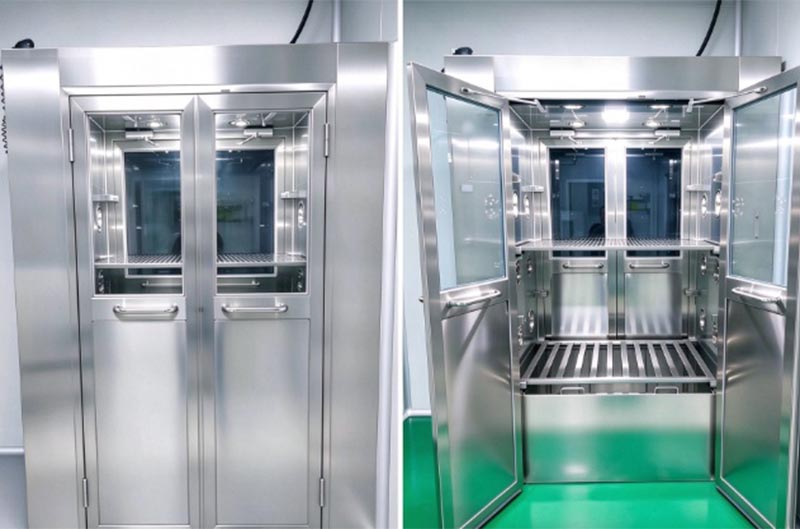
✅Electronic Interlocking Air-Shower Pass Box: The standard, mainstream choice; features automatic timing and audio-visual indicators. Suitable for standardized production lines in the pharmaceutical, electronics, and laboratory sectors.
✅Mechanical Interlocking Air-Shower Pass Box: Operates without electrical circuitry; designed for use in explosion-proof facilities or basic cleanroom zones where water and electricity are restricted. Does not feature automatic air-shower cycles; the fan must be started manually.
✅Fully Automatic Conveyor-Type Air-Shower Pass Box: Equipped with a conveyor belt and photoelectric sensors; features automatic door operation and automated material transport. Ideal for the continuous transfer of large volumes of small items; specifically designed for automated, dust-free production lines.
IV. Standard Operating Procedures (SOPs)
Essential for GMP validation
Pre-Transfer Checks
Ensure both doors are fully closed and the interlocking indicator lights are functioning correctly.
Verify that the pressure differential gauge reads between 10–30 Pa, with no abnormal pressure fluctuations.
Check that the UV lamp, fan, and control panel are free of fault alarms.
Wipe down and remove dust from the outer packaging of materials before transfer; items that are excessively large, tall, or prone to generating dust are prohibited.
Standard Operating Procedure
Open the outer door (on the non-clean side), place the materials inside, and close the door completely (the air shower system will not activate if the door is not fully closed).
The air shower will start automatically; do not touch the doors while it is running for the set duration.
Once the air shower cycle ends and the fan stops, the lock on the clean-side door will disengage; open the inner door to retrieve the materials.
Close the inner (clean-side) door immediately after removing the materials to complete the transfer process.
When the unit is to remain idle for an extended period, keep both doors closed and activate the UV lamp for at least 30 minutes for static disinfection.
Prohibited Actions
Do not force open the interlocking doors, and never attempt to open both doors simultaneously.
Do not open the doors while the air shower is in operation, as high-velocity airflow could carry dust into the cleanroom.
Do not place unpackaged raw materials or items that generate significant amounts of dust directly into the unit.
Do not open the doors while the UV lamp is on, to prevent skin burns or eye damage.
V. Equipment Validation and Maintenance
Content and Solutions
Airflow velocity testing (monthly): Measure airflow velocity at multiple points across the nozzles; readings below 18 m/s indicate a fan malfunction or a clogged filter.
HEPA filter PAO leak testing (annually): Scan the filter frame and media; replace the filter immediately if leakage exceeds the specified limit.
Pressure differential monitoring (recorded daily): A continuous drop in pressure differential indicates that the primary or HEPA filter is clogged with accumulated dust.
UV intensity testing (semi-annually): Replace the UV lamp if the irradiance falls below 70 μW/cm².
Interlock function testing (quarterly): Repeatedly operate the doors to verify the reliability of the interlocking mechanism, ensuring that the risk of multiple doors being open simultaneously is eliminated.
| Component | Maintenance Content | Cycle | Consequences of Failure |
| Pre-filter | Remove for washing or direct replacement | 1–3 months | Rapidly clogs the HEPA filter; decreased air velocity; pressure differential imbalance |
| HEPA High-efficiency Filter | PAO leak test; replace when pressure differential > 2 times the initial resistance | 6–12 months | Filtration failure; particles directly enter the clean area; product contamination |
| Ultraviolet Germicidal Lamp | Illuminance testing; replace aging lamp tubes | 6 months | Disinfection failure; microbial levels in the cabinet exceed standards |
| Door Seals | Wipe disinfection; replace if cracked or hardened | 1 year | Decreased airtightness; air cross-contamination between the two zones; loss of pressure in the clean area |
| Fan & Interlock Sensor | Function calibration; dust removal and lubrication | 3 months | Air shower fails to start; interlock failure; risk of cross-contamination |
Material Selection: 316L stainless steel is preferred for sterile and biological laboratories; 304 stainless steel is suitable for general electronics workshops; for dry, low-corrosion environments, powder-coated cold-rolled steel may be used.
Filtration Grade vs. Cleanliness Level: H14 HEPA filters are mandatory for Grade A/B sterile zones; H13 filters are the minimum requirement for Grade D or Class 100,000 (ISO 8) cleanrooms.
Interlock Mechanism: Purely mechanical interlocks should be used in explosion-proof environments; for automated production lines, fully automatic sensor-based conveyor systems are required.
Dimensional Allowance: The internal dimensions (length, width, and height) should be at least 100 mm larger than the items being transferred to prevent the items from obstructing the air nozzles and creating "dead zones" where no airflow reaches.
Disinfection/Sterilization: UV or ozone modules should be added for environments requiring strict microbial control; these features may be omitted in electronics workshops where the primary concern is only dust control.
Air-shower pass boxes are indispensable, standardized pieces of equipment within the contamination control systems of cleanroom facilities. Their core value lies in providing dual-layer protection—combining physical isolation with active purification—which distinguishes them from conventional pass boxes that offer only physical separation. In highly regulated sectors such as sterile pharmaceutical manufacturing, precision electronics, and biosafety, the equipment’s structural design, filtration, interlocking mechanisms, and decontamination capabilities must all comply with GMP and ISO cleanroom standards. Furthermore, a comprehensive documentation system covering operation, maintenance, and validation is essential to ensure the ongoing control of cross-contamination by particles and microorganisms, thereby maintaining a compliant and stable production or experimental environment.
