COMPANY NEWS
A One-Minute Guide to Maintaining Biological Clean Benches and Avoiding Common Pitfalls
According to the national metrological technical specification JJF 2053-2023, "Calibration Specification for Performance Parameters of Clean Benches," and the standard YY/T 1539-2017, "Medical Clean Benches," a biological clean bench (also known as an ultra-clean bench or medical clean bench) is a cabinet-style, localized purification device. Its core function is to provide a localized working environment with a cleanliness level superior to ISO Class 5 (equivalent to the traditional Class 100). It not only prevents dust and microorganisms from the external environment from contaminating experimental samples but also, through specialized protective design, mitigates the impact of potentially hazardous microorganisms—encountered during experiments—on both the personnel and the surrounding environment.
I. Core Operating Principle
Air Filtration and Directional Airflow
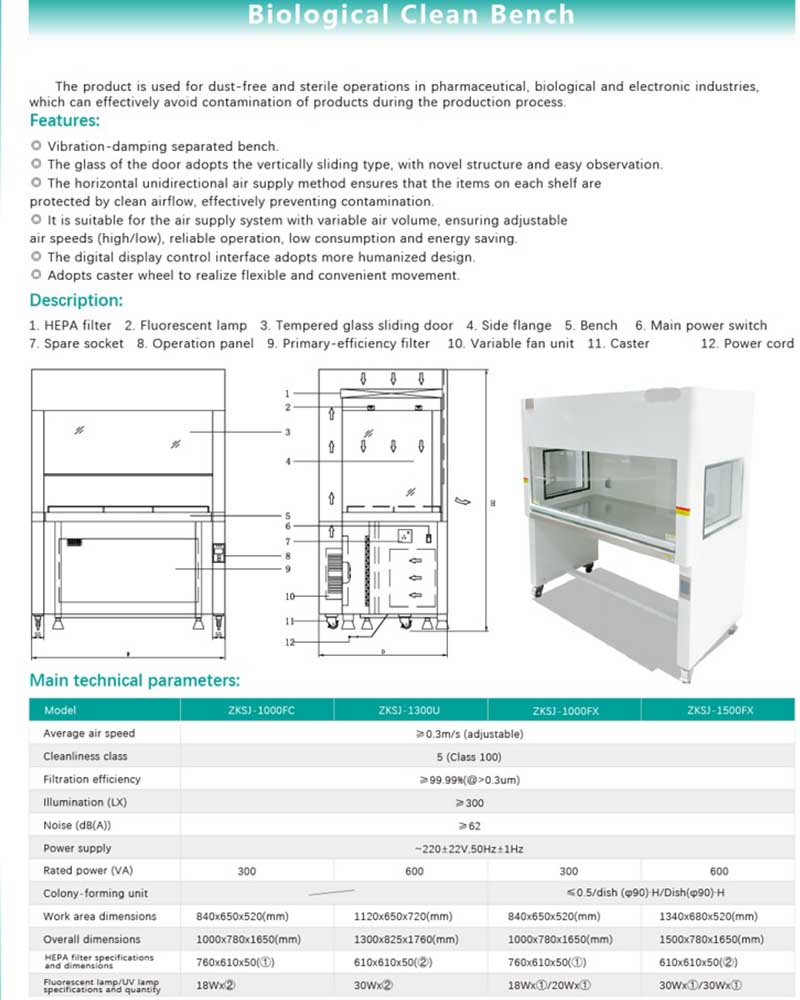
The core logic of a biological clean bench is "multi-stage filtration combined with directional airflow." By precisely controlling air movement, it creates a sterile, clean micro-environment. The overall operational process consists of three key steps, each governed by specific technical standards:
Q: Air Intake and Pre-filtration
A: The unit features a built-in centrifugal fan that draws ambient air into the enclosure. The air first passes through a pre-filter (an intermediate-efficiency filtration system), which removes larger airborne particles—such as dust and hair—thereby preventing these coarse impurities from clogging the primary filtration components and extending the service life of the downstream high-efficiency filters. This stage serves as a "preliminary safeguard" to ensure filtration efficiency and forms the foundation for the equipment's long-term, stable operation.
Q: High-Efficiency Filtration
A: Pre-filtered air is pressurized into a plenum and then forced through a High-Efficiency Particulate Air (HEPA) filter—the "core" of a biological clean bench. According to the GB/T 13554-2020 standard for HEPA filters, these units must achieve a filtration efficiency of at least 99.95% for particles with a diameter of 0.3 μm (some high-end models utilize Ultra-Low Particulate Air, or ULPA, filters with even higher efficiency). This effectively captures airborne contaminants, such as microorganisms and fine dust, ensuring that the discharged air meets ISO Class 5 cleanliness standards.
Q: Directional Airflow and the Creation of a Clean Zone
A: Once filtered, the clean air is delivered as a unidirectional flow (either vertical or horizontal) with a uniform and stable cross-sectional velocity—typically ranging from 0.20 to 0.50 m/s—covering the entire workspace. This directional airflow creates an "air curtain" barrier; it prevents external contaminants from entering while simultaneously sweeping away any trace pollutants generated during operations, ensuring the workspace remains sterile and clean. Furthermore, biological clean benches feature exhaust filtration: air is passed through a HEPA filter before being discharged, which prevents potentially harmful microorganisms from the workspace from contaminating the laboratory environment. Additionally, an inward-drawing air curtain is maintained at the access opening, preventing the escape of clean air and shielding the interior from external airflow disturbances, thereby further enhancing protection.
II. Detailed Classification
Vertical Flow vs. Horizontal Flow
Classification by Airflow Direction
Biological Clean Benches
01: Vertical Flow Biological Clean Benches
In these units, clean air flows vertically downward from a HEPA filter located at the top, passing through the workspace. This provides direct, uniform airflow coverage that is less susceptible to disruption from the movements of personnel working in front of the unit; consequently, this is the most common type used in laboratories today. The work surface is typically constructed from brushed SUS304 stainless steel, which is corrosion-resistant and easy to clean. Some models feature a counterbalanced sliding sash that can be positioned at any height, offering greater operational convenience.
Typical Applications: General aseptic procedures, such as cell culture (non-pathogenic), sterile dispensing, tissue sample processing, and microbial inoculation. These units are widely used in fields including biomedicine, food testing, and agriculture, forestry, animal husbandry, and fisheries.
02: Horizontal Laminar Flow Biological Clean Bench
Clean air is blown horizontally from a HEPA filter located at the rear (or side) toward the front opening. The workspace is open and unobstructed, facilitating easy observation and manipulation; this design is well-suited for experimental tasks that require a larger horizontal working area. The front is typically open, with transparent, durable acrylic side panels that provide excellent visibility.
Typical Applications: Use with microscopes, operation of small-scale experimental equipment, preparation of routine microbiological smears, etc. Note: Because the airflow is directed toward the operator, this unit is not suitable for handling potentially hazardous microbiological samples.
III. Key Parameters
Essential Reference for Selection and Use
When selecting or using a biological clean bench, certain core parameters directly determine its performance and suitability. All parameters referenced here align with JJF 2053-2023, "Calibration Specification for Performance Parameters of Clean Benches," and other relevant industry standards. Focus on the following five aspects:
Q: Cleanliness Class
A: Core Requirement: The cleanliness of the work area must reach ISO Class 5 (i.e., no more than 3,520 particles ≥0.5 μm per cubic meter of air). This is the fundamental standard for a biological clean bench; equipment that fails to meet this level cannot satisfy the requirements for aseptic experiments.
Q: HEPA Filter Performance
A: Filtration Efficiency: The filter must have an efficiency of at least 99.95% for 0.3 μm particles. Depending on experimental needs, one may opt for an Ultra-Low Particulate Air (ULPA) filter, which offers even higher efficiency. Additionally, consider the filter's service life—typically 1 to 2 years. Some units are equipped with a filter failure alarm to ensure timely replacement.
Q: Airflow Velocity
A: Vertical-flow clean benches: The average airflow velocity in the work area should be 0.3–0.6 m/s (adjustable). Horizontal-flow clean benches: The average airflow velocity should be 0.2–0.5 m/s. The airflow must be uniform and stable; otherwise, "dead zones" (stagnant air pockets) may form, creating a risk of contamination.
Q: Noise and Vibration
A: Noise level ≤ 67 dB; vibration (half-peak amplitude) ≤ 5 μm (in X, Y, and Z directions). Excessive noise and vibration can interfere with experimental procedures and compromise sample stability; equipment designed with ergonomics in mind is better suited for long-term use.
Q: Auxiliary Features
A: Includes a UV germicidal lamp (with a 0–999 min timer for pre-operation sterilization), interior lighting (independently controlled to ensure clear visibility), an LCD control system (for real-time monitoring of parameters such as airflow velocity and filter lifespan), splash-proof electrical outlets, and ports for water or gas supply. These features enhance both operational convenience and safety.
IV. Avoiding Pitfalls in Procurement
When purchasing biological clean benches, many laboratories fall into common misconceptions. This not only leads to a waste of budget but can also create safety hazards. Drawing on industry best practices, here is a guide to help you make informed purchasing decisions:
Misconception 1: A more powerful filtration system automatically means better equipment.
Reality: While the filtration system is a core component, it is not the only critical factor. If the airflow design is poorly conceived, even a highly efficient HEPA filter may fail to ensure proper circulation, leading to "dead zones" where contaminants can accumulate. In high-risk environments—such as those used for cell culture or virological research—airflow uniformity and dynamics are just as important as filtration efficiency. When selecting equipment, one must consider both filtration performance and airflow design, rather than simply assuming that "more powerful filtration is always better."
Misconception 2: All biological safety cabinets (BSCs) are suitable for any type of experiment.
Reality: Different types of BSCs are designed for specific applications and are not interchangeable. Class I cabinets protect only the operator; Class II cabinets provide protection for the operator, the sample, and the environment; and Class III cabinets are intended for high-risk experiments. Choosing the wrong type can lead to issues such as sample contamination or the exposure of personnel to hazardous materials. For instance, using a Class I or a standard Class II cabinet when handling highly pathogenic microorganisms would fail to prevent the escape of these agents, posing a severe safety risk.
V. Operational Procedures and Routine Maintenance
Extending Service Life and Ensuring Safety
The service life and operational stability of a biological clean bench depend on proper operation and regular maintenance. All procedures should be carried out in accordance with the standard YY/T 1539-2017 "Medical Clean Benches" and the equipment’s operating manual. These are categorized into two sections: "Operational Procedures" and "Routine Maintenance."
Standard Operating Procedure (SOP)
Biological Clean Bench
01: Pre-startup Preparation
Turn on the workstation fan and the ultraviolet (UV) germicidal lamp 30 minutes in advance to disinfect the work area. Once disinfection is complete, turn off the UV lamp and switch on the interior lighting. Wait for the airflow to stabilize (approximately 5–10 minutes) before beginning any work.
02: Preparation Before Operation
Personnel must wear sterile gloves, a face mask, and a lab coat. Wipe all experimental equipment (such as Petri dishes and reagent bottles) with 75% alcohol for disinfection, then place them neatly within the work area, ensuring they do not obstruct the airflow.
03: During Operation
Reach into the work area only with your hands; keep the rest of your body outside. Do not open the workstation door unnecessarily, and ensure no non-sterile items are brought into the work area. Minimize large or sudden movements while working to prevent airflow disruption.
04: Post-operation
Secure all experimental equipment, wipe down the work surface with 75% alcohol, and remove any residual samples or reagents. Leave the fan running for an additional 30 minutes to clear out any remaining contaminants, then turn off both the fan and the lighting.
Key Points for Routine Maintenance:
✅ Filter Maintenance: Clean the pre-filter once a month (use compressed air or rinse with clean water; ensure it is completely dry before reinstallation). Test the filtration efficiency of the HEPA filter annually; if the efficiency falls below 99.95% or if any damage is detected, replace it immediately and recalibrate the equipment’s performance.
✅ Cleaning of Work Surfaces and Exterior: After daily use, wipe down the work surface, the interior of the access opening, and the exterior of the unit with 75% alcohol. Perform a thorough, comprehensive cleaning once a week to prevent dust accumulation.
✅ Parameter Calibration: Conduct a full performance calibration at least once a year—covering parameters such as cleanliness, airflow velocity, noise levels, and vibration—in accordance with the JJF 2053-2023 standard. This must be performed by qualified professionals to ensure the equipment meets all regulatory requirements.
✅ Other Maintenance: Regularly check the operating status of the fan; if abnormal noise or unstable airflow occurs, perform repairs promptly. Replace UV lamps after 1,000 hours of use to maintain effective sterilization. If the equipment is not in use for an extended period, power it on for 30 minutes once a month to prevent component degradation.
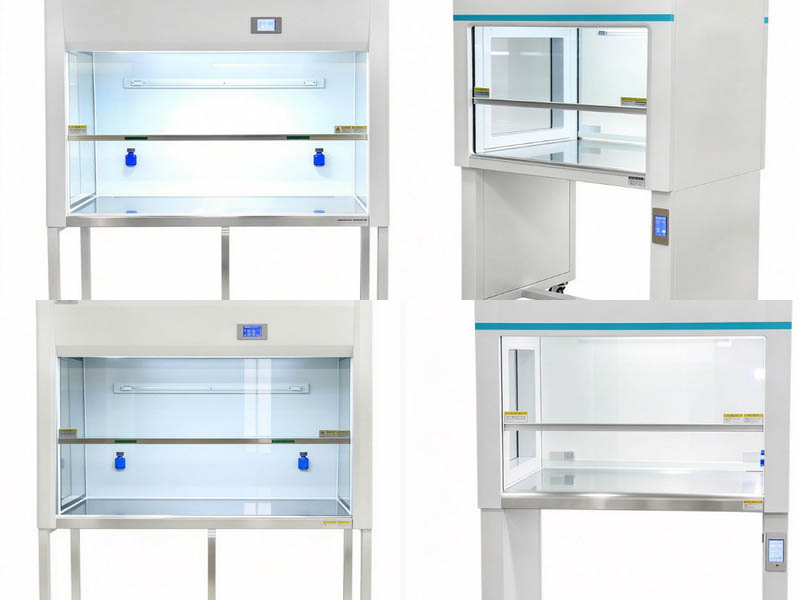
In a laboratory setting, biological clean benches, biosafety cabinets, and fume hoods are frequently confused. However, they differ significantly in terms of what they are designed to protect, their operating principles, and their intended applications; selecting the wrong piece of equipment can lead to serious consequences.
Essentially, a biological clean bench creates a controlled, clean micro-environment through precise airflow management and high-efficiency filtration. It serves a dual purpose: protecting the "purity" of experimental samples—thereby ensuring the accuracy and reliability of experimental results—while also providing basic protection for laboratory personnel by reducing the risk of biological contamination.
From definitions and operating principles to classification, procurement, usage, and maintenance, every aspect relies on scientific standards and protocols. Whether you are new to the laboratory or an experienced professional, mastering the core knowledge regarding biological clean benches will help you avoid operational errors and common pitfalls during procurement. Furthermore, it ensures that the equipment delivers maximum value, safeguarding both experimental safety and scientific research outcomes.
