COMPANY NEWS
Technical Analysis of Cargo Air Showers: A Key Barrier for Clean Environments
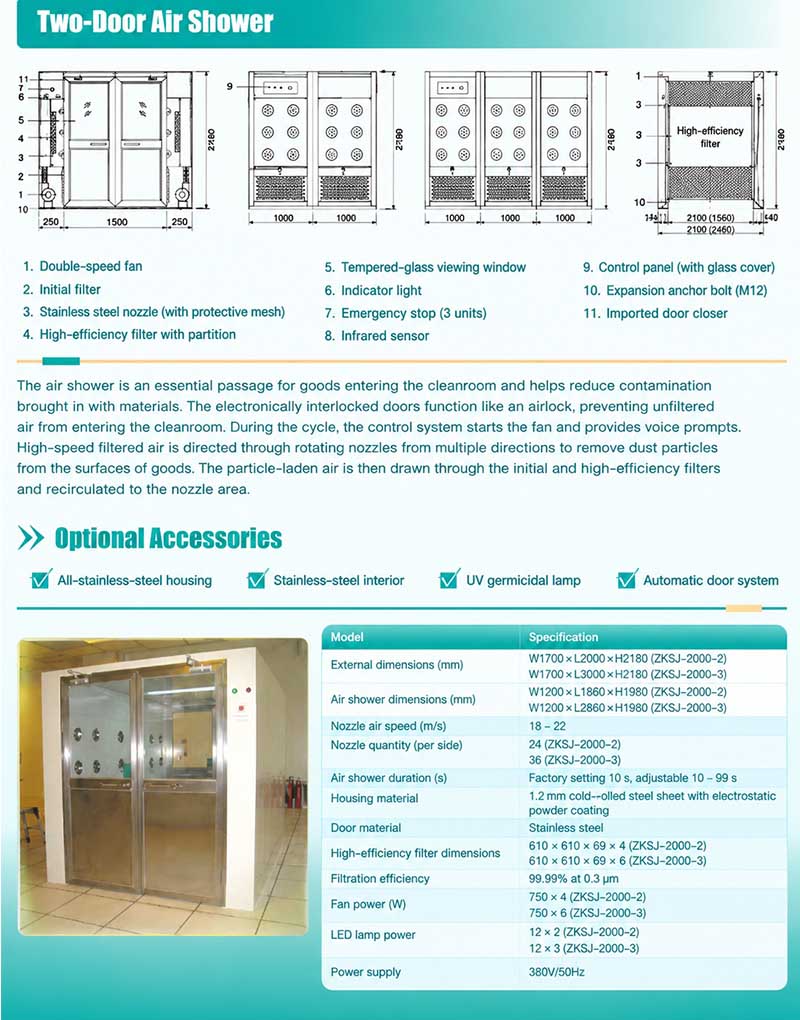
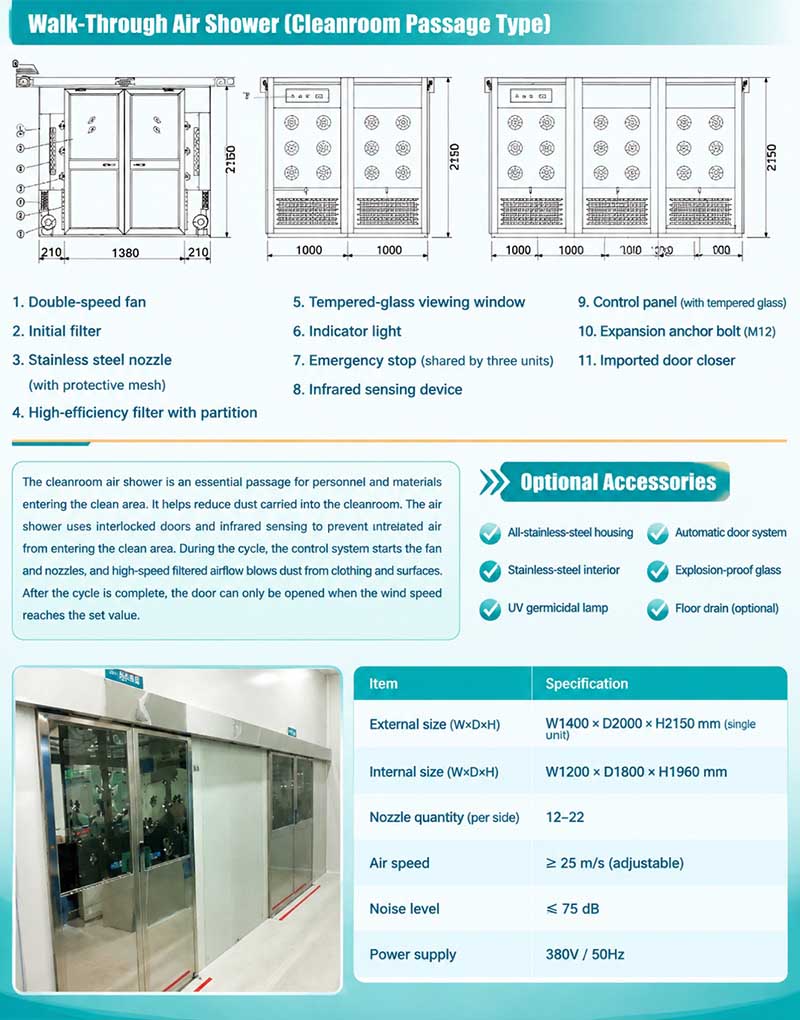
A cargo air shower is an essential purification passage between a cleanroom and a non-cleanroom environment. Specifically designed to remove dust and impurities from the surfaces of raw materials, packaging, equipment, pallets, and other goods, it prevents contaminants from entering the cleanroom at the source. As such, it serves as a critical piece of equipment for ensuring both compliance with cleanroom environmental standards and the quality of the final product. Drawing on national standards—including JG/T 296-2010 "Air Shower" and GB 50073-2013 "Code for Design of Cleanrooms"—this article provides a comprehensive, professional analysis covering the definition, operating principles, structure, selection, maintenance, and industrial applications of cargo air showers.
I. Core Definition and Functional Positioning
Dust Removal, Purification, and Environmental Isolation
A cargo air shower is a piece of equipment designed for surface purification of materials (in accordance with the JG/T 296-2010 standard). It utilizes high-speed, clean airflow to blow away surface dust from cargo. Simultaneously, its dual-door electronic interlocking mechanism functions as an airlock, preventing unpurified air from entering the cleanroom—thereby serving the dual purpose of "material purification" and "environmental isolation."
Dust Removal and Purification: High-velocity airflow dislodges dust particles (≥0.3 μm) from the surfaces of goods, reducing the contamination load in cleanroom areas.
Environmental Isolation: An interlocked dual-door system prevents air exchange between clean and non-clean zones, maintaining stable pressure differentials within the cleanroom.
Compliance Assurance: Meets cleanroom certification requirements for industries such as food, pharmaceuticals, and electronics (e.g., GMP, ISO 14644).
II. Operating Principle
Circulation Logic for High-Efficiency Purification
The purification process within a cargo air shower follows a closed-loop principle of "filtration – air showering – circulation." The core workflow is as follows:
Airflow Generation: The fan activates, drawing in ambient air. The air passes through a primary filter (G4 grade) to capture large dust particles and fibers before entering the static pressure plenum.
Deep Filtration: The air is processed through a high-efficiency filter (H13 grade, 99.99% efficiency at 0.3μm), resulting in a clean airflow.
High-Velocity Air Showering: The clean airflow is discharged at a high velocity of 22–30 m/s through adjustable nozzles (spherical or slotted types) from multiple directions onto the surface of the cargo, dislodging any attached contaminants.
Recirculatory Purification: The dust-laden air re-enters the primary filtration stage, repeating the filtration cycle to consistently maintain the required level of cleanliness within the air shower zone.
Key Technical Parameters
| Parameter | Technical Requirements | Recommended Industry Values |
| Air Jet Velocity | When the cargo air shower chamber width is ≥1200 mm, the minimum air jet velocity of the spherical nozzles shall be 23–27 m/s. | 25–30 m/s (≥30 m/s for food and pharmaceutical applications) |
| Air Shower Duration | Adjustable in compact units; ≥10 s | 30–60 s (suitable for large cargo) |
| Number of Air Nozzles | For a reference length of 1600–2400 mm: ≥18 nozzles | 24–36 nozzles (both sides and top) |
| Cleanliness Level | Air shower zone shall meet Class 7 requirements in accordance with GB 50073-2013. | Match the required cleanliness classification of the cleanroom (ISO Classes 5–8) |
| Noise Level | ≤68 dB(A), measured 1 m outside the door | ≤65 dB(A) (for high-cleanliness environments) |
III. Core Structure and Material Specifications
Enclosure, Filtration, Airflow, and Control Systems
Enclosure: Sealed, welded structure with a smooth, dust-free surface; available in SUS304/201 stainless steel (thickness ≥1.2mm) or powder-coated cold-rolled steel.
Filtration System: Multi-stage contaminant removal using a primary filter (non-woven fabric/synthetic fiber) and a high-efficiency filter (HEPA/ULPA).
Air Supply System: High-efficiency, low-noise fan (maintaining airflow within a 10% variance even with a 50% change in air pressure), equipped with vibration-dampening and sound-insulating components.
Nozzle System: Spherical nozzles (diameter ≥20mm, adjustable angle ≥90°) or slotted nozzles, designed to provide full-surface coverage of the cargo.
Control System: Infrared sensor (triggered by cargo), electronic interlock (for dual-door configurations), adjustable air-shower duration, and an emergency stop function.
Doors: Safety glass or stainless steel doors, fitted with sealing gaskets; designed for manual opening in the event of a power failure.
| Industry | Recommended Material | Key Requirements |
| Food Processing | SUS304 Stainless Steel | Corrosion-resistant, easy to clean and disinfect, no hygienic dead corners |
| Pharmaceutical Aseptic Areas | 304 Stainless Steel / Cold-Rolled Steel Sheet (Baked Finish) | Resistant to disinfectants, no particle shedding, GMP-compliant |
| Semiconductor Electronics | 304 Stainless Steel (Anti-Static) | Anti-static properties, wear resistance, suitable for high-level cleanrooms |
| General Cleanrooms | Cold-Rolled Steel Sheet with Baked Finish | Cost-effective, meets basic purification requirements |
IV. Selection of Cargo Air Showers:
Guidelines and Key Points
| Classification | Type | Applicable Scenarios |
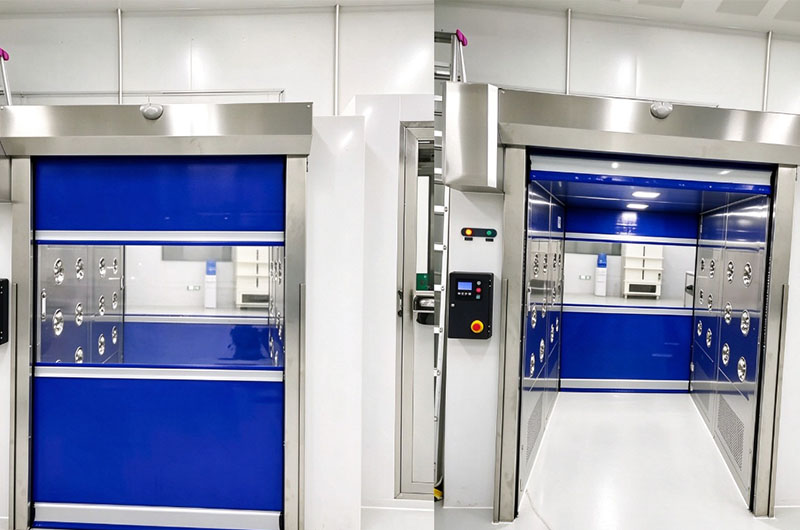
| By Structure | Compact Cargo Air Shower | For 1–2 items per pass; passage width of 1200–2000 mm |
| Tunnel-Type Cargo Air Shower | Continuous passage of pallets or forklifts; length ≥6 m; suitable for high-throughput applications | |
| By Door Type | Manually Operated Double Doors | Low-throughput, cost-sensitive applications; equipped with door closers |
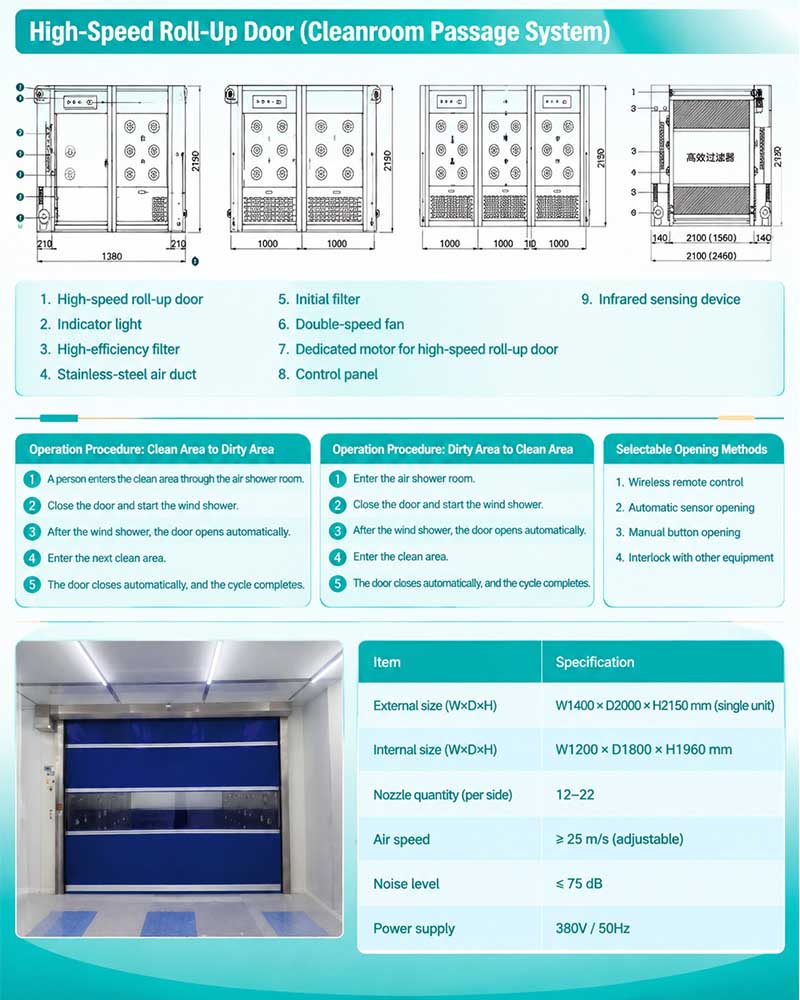
| High-Speed Rolling Doors | High-throughput, automated production lines; improves passage efficiency | |
| By Air Shower Configuration | Double-Sided Air Jets | Standard cargo; basic dust removal requirements |
| Top and Side Air Jets | Large cargo or pallets; removes dust from both the bottom and top surfaces | |
| Three-Sided / Four-Sided Air Jets | Precision equipment or sterile materials; applications requiring high cleanliness levels |
Key Selection Criteria – Dimensional Compatibility:
The internal clear dimensions must be 300–500 mm larger than the cargo, ensuring a gap of at least 200 mm between the cargo and the air nozzles on both sides to eliminate "dead zones" during the air-purging process.
Air Velocity Requirements: Higher cleanliness standards necessitate higher air velocities—≥28 m/s for ISO Class 5 (Class 100), ≥25 m/s for ISO Class 7 (Class 100,000), and ≥30 m/s for food raw materials.
Throughput Capacity: Select the unit based on cargo volume—chamber-style units are suitable for 1–2 items at a time, while tunnel-style units accommodate continuous flow (e.g., on pallets or via forklift) to prevent congestion that could compromise the effectiveness of the air-purging process.
Functional Customization: For high-cleanliness environments, consider adding features such as UV germicidal lamps, differential pressure monitoring, and variable-frequency drive (VFD) fans (to improve energy efficiency and reduce noise).
V. Installation Specifications and Acceptance Criteria
Core Installation Requirements
1. Installation Requirements and Location Selection:
Position the unit at the boundary between the cleanroom and non-cleanroom areas, ensuring it serves as the mandatory passage for goods entering the cleanroom, with no bypass routes;
Environmental Conditions: The installation environment must have a temperature of 5–40°C, relative humidity of 30%–85%, and atmospheric pressure of 86–106 kPa;
Electrical Connections: Power supply must be 380V/50Hz with a cable cross-sectional area of ≥6 mm²; ensure secure terminal connections and equip the system with an all-pole switch and a circuit breaker;
Sealing: Seal all joints between the unit housing and the floor or walls; the leakage rate must be ≤0.5 m³/h to prevent air infiltration;
Commissioning: After installation, operate the unit in an empty state for 1 hour; verify nozzle air velocity, cleanliness levels, and the door interlocking function—the unit may only be put into service once all parameters meet the required standards.
2. Key Acceptance Criteria (JG/T 296-2010)
Air nozzle velocity ≥ standard value; uniformity deviation ≤ 10%.
Cleanliness in the shower zone ≥ Class 7; airborne particle concentration ≤ 3,520 particles/m³ (for particles ≥ 0.5 μm).
Door interlocking function: both doors must remain locked during the shower cycle; doors may be opened only after a delay of ≥ 5 seconds following the end of the shower cycle.
Noise level ≤ 68 dB(A); leakage current ≤ 10 mA; grounding resistance ≤ 0.1 Ω.
VI. Maintenance and Servicing
Inspection and Cleaning
Check the operating status of the fan: ensure there are no abnormal noises or vibrations, and that the airflow speed is stable.
Clean the nozzles: ensure they are free of blockages and securely fastened, and that the nozzle angles are correctly set.
Inspect the door unit and sealing strips: ensure the seals are intact and the door operates smoothly.
Check the control system: verify that sensors are responsive and indicator lights are functioning properly.
VII. Industry Applications and Compliance Requirements
Food, Pharmaceuticals, Semiconductors, Precision Manufacturing
| Industry | Core Requirements | Applicable Standards |
| Food Processing | Prevent microbial and physical contamination to ensure food safety | HACCP, GB 14881, ISO 22000 |
| Pharmaceutical Industry | Ensure sterility and prevent product contamination and cross-contamination | GMP (Sterile Products), ISO 14644 |
| Semiconductor Electronics | Remove particles to prevent chip short circuits and performance degradation | ISO 14644 (Cleanroom Class 100), IPC-7525 |
| Biopharmaceuticals | Control microbial contamination to ensure laboratory and production safety | GLP, GMP, ISO 13485 |
| Precision Manufacturing | Prevent contamination of precision components and ensure product accuracy | ISO 14644 (Classes 5–7) |
As the primary purification line of defense for the logistics of goods entering a cleanroom, the performance of a cargo air shower directly determines the environmental compliance of the cleanroom and the stability of product quality. Selection must strictly adhere to national standards—such as JG/T 296-2010 and GB 50073-2013—while tailoring parameters like airflow velocity, dimensions, and materials to the specific requirements of the industry. Furthermore, installation and maintenance must follow standardized procedures to ensure the long-term, stable operation of the equipment.
In sectors with stringent cleanliness requirements—such as food processing, pharmaceuticals, and electronics—a cargo air shower is more than just a piece of equipment; it is a critical safeguard for regulatory compliance and product quality. Only through scientific selection, compliant installation, and regular maintenance can its purification and isolation functions be fully realized, thereby establishing a solid foundation for the stable operation of a cleanroom.
VIII. Core Advantages of AN Air Showers
Direct-from-factory, precision-engineered materials, custom non-standard specifications, and reliable after-sales support
Q: What is the certification status of the AN air shower?
A: Fully compliant and industry-standard; suitable for a wide range of sectors.
The unit strictly adheres to national standards JG/T 296-2010 and GB 50073-2013, and fully aligns with the certification requirements of GMP and ISO 14644. It ensures full compliance across diverse applications, including pharmaceuticals, food processing, electronics, and new energy.
Q: How effective is the cargo air shower at purification?
A: Highly efficient purification with reliable dust removal.
Features include a high airflow velocity of 25–32 m/s, 360° adjustable nozzles, H13 high-efficiency particulate air (HEPA) filters (99.99% efficiency at 0.3 μm), and an electronic dual-door interlock system—effectively blocking contaminants from entering the cleanroom at the source.
Q: What is the build quality of the cargo air shower?
A: Crafted with precision using durable, easy-to-clean materials. The enclosure is constructed from thickened SUS304 stainless steel with seamless welding, ensuring no unsanitary crevices. It is resistant to disinfectants, anti-static, and corrosion-resistant—making it suitable for high-cleanliness, high-humidity, or low-temperature operating environments.
Q: Is customization available?
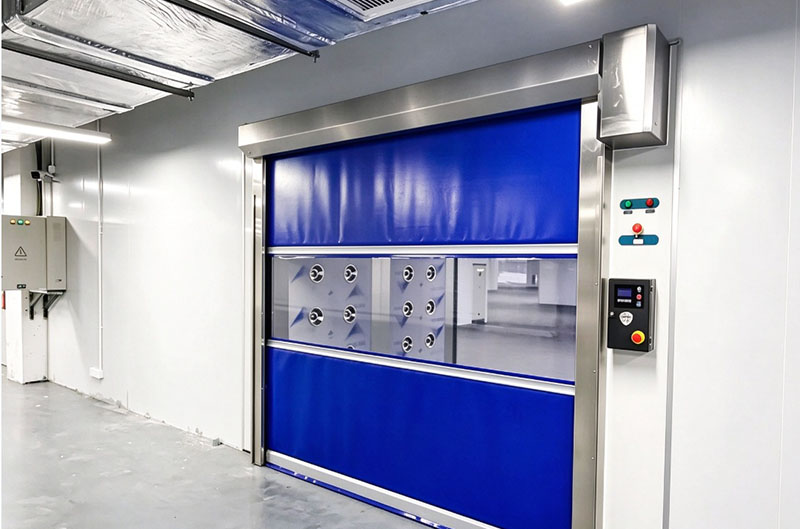
A: We offer non-standard customization to cover a full range of operational scenarios. Options include tunnel-style, high-speed roll-up door, and low-temperature configurations, all compatible with pallets, forklifts, and large cargo. Features include infrared sensing, intelligent voice prompts, and energy-saving variable-frequency drives. The system offers a high degree of automation, with an "unmanned" air-shower mode that further reduces power consumption.
