COMPANY NEWS
Product Primer | Understand Grade A Laminar Flow Hoods in 3 Minutes: Principles, Functions, and Application Scenarios
In the core areas of pharmaceutical manufacturing facilities, laboratories, and high-end medical device production sites, an invisible "battlefield" exists. A single speck of dust or an inadvertent bacterium can render an entire batch of medicine ineffective, invalidate experimental data, and even pose a threat to patients' lives.
How can one create and maintain a "pristine, dust-free sanctuary" within such a confined space? The answer lies in the Grade A laminar flow hood.
Today, let us pull back the veil and explore how this high-tech equipment functions—and discover how industry leaders like AN have perfected it to the highest standard.
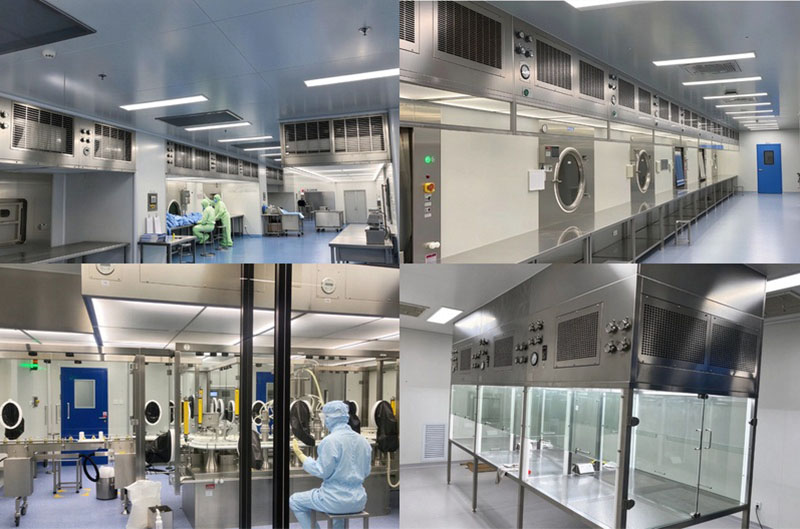
I. Localized Ultra-Purification Guardian
What is a Grade A laminar flow hood?
Simply put, a Grade A laminar flow hood is an air purification unit—available in either mobile or stationary configurations—designed to provide the highest level of clean environment. Think of it as a "protective clean enclosure" tailored specifically for critical operations.
01. What does "Grade A" signify?
"Grade A" represents the highest level of air cleanliness defined by international cleanroom standards (such as ISO 14644 and GMP). In the operational area, it mandates that there be no more than 3,520 airborne particles (≥0.5 microns in size) per cubic meter of air. To put this into perspective: typical indoor air can contain tens or even hundreds of millions of such particles per cubic meter. A "Grade A" environment is, effectively, a realm of near-"absolute cleanliness."
| Cleanroom Grade | Maximum Permissible Particle Concentration (particles/m³) | Maximum Permissible Microbial Concentration | Air Velocity (m/s) | ||
| ≥0.5 μm | ≥5 μm | Airborne Microbial Count (CFU/m³) | Settle Plate Count (CFU/plate) | ||
| Static / Dynamic | Static / Dynamic | Dynamic | Dynamic | ||
| Grade A (Dynamic Class 100) | 3.5×10³ / 3.5×10³ | 0 / 0 | 1 | 0.125 | 0.36–0.54 |
| Grade B (Static Class 100) | 3.5×10³ / 3.5×10³ | 0 / 2.0×10³ | 10 | 0.625 | --- |
| Grade C (10,000) | 3.5×10⁵ / 3.5×10⁵ | 2.0×10³ / 2.0×10³ | 100 | 6.25 | --- |
| Grade D (100,000) | 3.5×10⁶ / ------ | 2.0×10³ / ------ | 200 | 12.5 | --- |
02. What is "laminar flow"?
"Laminar flow" refers to a specific pattern of airflow. A fan within a laminar flow hood draws in ambient air and pushes it through a high-efficiency HEPA or ULPA filter. The resulting clean air is then delivered—much like a piston—at a uniform velocity and in a consistent direction (either vertical or horizontal). This airflow moves steadily and in parallel across the entire workspace, instantly "sweeping away" any particles or bacteria generated during operations. By preventing these contaminants from spreading or causing cross-contamination, the airflow creates an invisible barrier.
II. Cutting-Edge Technology Builds a Reliable Barrier
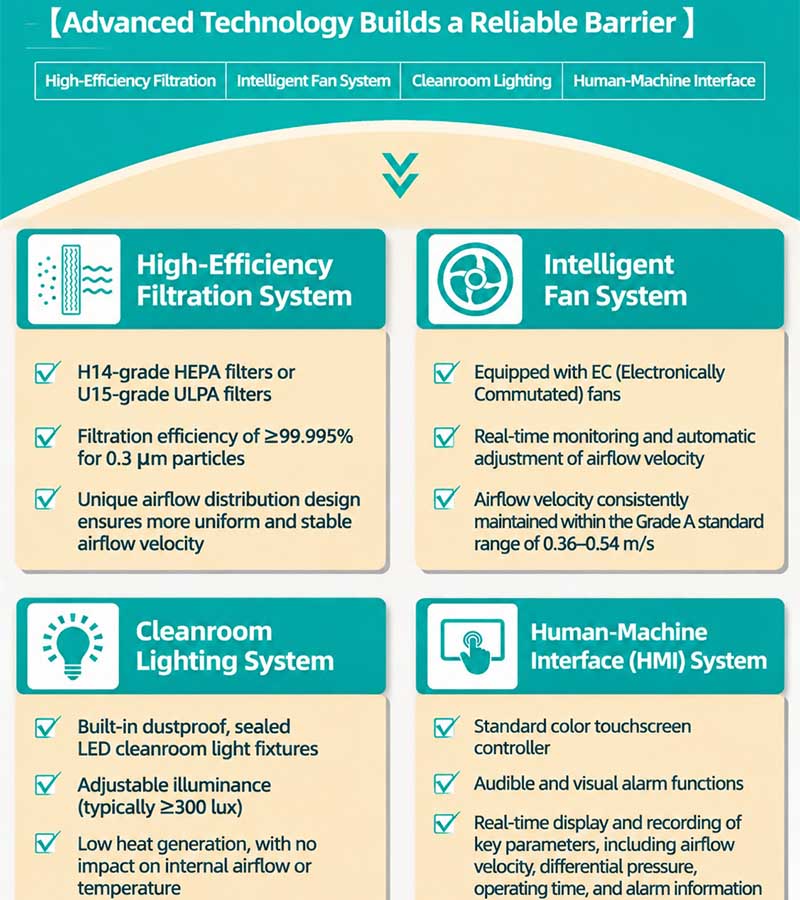
Taking the Grade A laminar flow hood from AN as an example:
As a leader in cleanroom environment solutions, AN’s Grade A laminar flow hood perfectly embodies the company’s commitment to reliability, efficiency, and intelligence. Let’s examine its core, high-performance features:
III. Ubiquitous Cleanliness Protection
Application Scenarios for Grade A Laminar Flow Hoods
Pharmaceutical Industry: Filling and sealing of pharmaceutical preparations; sampling and weighing of raw materials; replenishment of materials in biosafety cabinets, etc.
Biological Laboratories: Sensitive experiments such as cell culture, PCR procedures, and microbial inoculation.
Medical Devices: Packaging of high-value consumables; assembly and inspection of implants.
Food Testing: Sample preparation and analysis.
Precision Instruments/Electronics Industry: Assembly of precision components that are highly sensitive to particulate contamination.
From pharmaceutical production to electronics manufacturing, and from laboratories to food processing facilities, Grade A laminar flow hoods utilize invisible, clean airflow to safeguard the quality and safety of a wide array of products we encounter in our daily lives. Through a relentless commitment to refining materials, manufacturing processes, and core components, AN has made this "clean protection" more precise, more reliable, and more cost-effective. In an era defined by the pursuit of uncompromising quality, such specialized purification equipment serves as a vital cornerstone for high-quality development across diverse industries.
