COMPANY NEWS
Fortifying the Cleanliness Barrier | Comprehensive Validation of Laminar Flow Pass Boxes
A laminar-flow pass-through box serves as an airlock barrier between areas of differing cleanroom classifications. Unlike standard pass-through units, it incorporates a unidirectional laminar-flow system and a HEPA filter; it is primarily used for the transfer of materials into or between high-risk cleanroom zones, such as those classified as Grade A or Grade B. Far more than a simple transfer chamber, its reliable performance—ensured by unidirectional laminar flow, high-efficiency filtration, and interlocking safety mechanisms—is directly critical to product quality and compliance with GMP (Good Manufacturing Practice) standards in sectors including pharmaceuticals, bioproducts, cell laboratories, microelectronics, and medical device manufacturing. The delivery of the equipment does not equate to a successful, compliant installation; a comprehensive validation process is essential to complete the delivery lifecycle.
I. Three Key Stages of Validation, Interlinked
DQ/IQ/OQ
Q: Design Qualification (DQ)
A: Based on the User Requirements Specification (URS), the design is reviewed—including blueprints, airflow schemes, chamber materials, dual-door interlock logic, filter selection, fan configuration, monitoring instrumentation, and sterilization modules. A risk assessment is conducted to identify potential risks such as material transfer issues, airflow disturbances, or leaks, with corresponding control measures established. It is verified that the equipment design meets operational requirements—such as the specified cleanroom class, pressure differential, recovery (self-cleaning) time, and noise levels—to prevent design flaws at the source. Deliverables include the DQ report, blueprints, and risk assessment documentation.
Q: Installation Qualification (IQ)
A: Upon unboxing, the main equipment, accessories, and instrument calibration certificates are verified. Checks are performed on the installation location, leveling, anchoring methods, power supply connections, ductwork, sealing structures, and grounding. Material certifications, panel welds, and the integrity of sealing gaskets are inspected; it is also confirmed that the surrounding layout does not interfere with the laminar airflow. Any installation deviations are documented and resolved (closed-loop process). Final verification ensures the equipment is installed strictly according to the blueprints and URS requirements, and an equipment ledger along with a spare parts list is established.
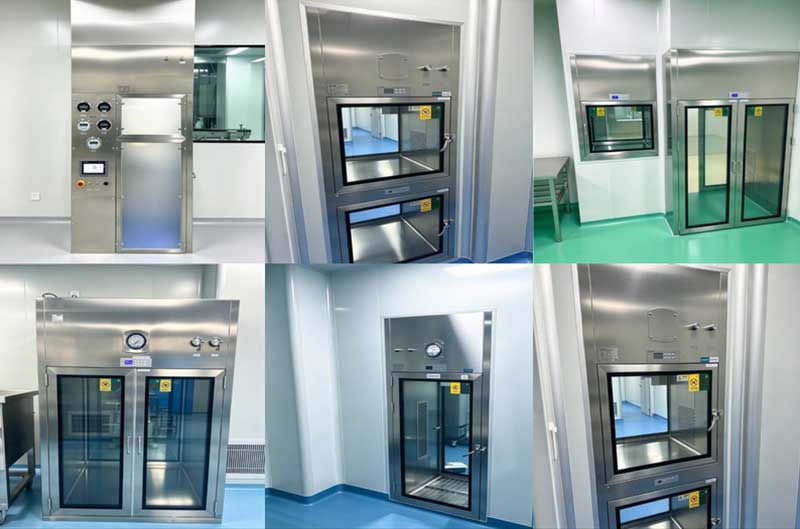
Operational Qualification (OQ)
01: Dual-Door Interlock Function Test
Verifies that both doors cannot be opened simultaneously, preventing direct connection between clean zones of different cleanliness classes. Tests the interlock logic during power outages or system failures, and ensures that audible and visual alarms function correctly.
02: PAO Leak Testing
A comprehensive scan of the filter media, frames, and seals is performed. A leak rate of ≤0.01% at any single point is required to eliminate the risk of aerosol penetration.
03: Laminar Airflow Velocity and Uniformity Test
Ensures the laminar airflow velocity is maintained at 0.45 m/s ± 20% (0.36–0.54 m/s). Multi-point sampling is conducted to ensure that velocity fluctuations across the entire cross-section remain within controlled limits.
04: Recovery (Self-Cleaning) Time Test
Following the artificial introduction of particles, the time required for the particle concentration within the chamber to return to the target cleanliness class is measured, confirming the system’s ability to rapidly restore a clean state after contamination.
05: Cleanliness Testing
Measurement of airborne particles (0.5μm, 5μm) under static conditions, in accordance with the required cleanliness classification (Grade A / Grade B).
II. Validation of Laminar Flow Pass-Through Boxes
Common Pitfalls and Selection Guidance
✅ Testing only for cleanliness without performing PAO (polyalphaolefin) leak testing. Leaks at the filter frame seal are a frequent, hidden source of contamination; while particle counts may pass under static conditions, leaks can occur when the door is opened during operation.
✅ Omitting airflow visualization (smoke testing). Eddies—invisible to the naked eye—can trap particles and microorganisms during the transfer of materials, leading to cross-contamination.
✅ Testing interlocks only under normal power conditions, failing to verify failure modes (e.g., during power outages or malfunctions). If interlocks fail during such events, it can directly compromise the separation between clean zones of different classifications.
✅ Lacking risk assessments during the Design Qualification (DQ) phase or providing vague User Requirement Specifications (URS), which often leads to extensive rework during later equipment modifications or changes.
✅ Conducting Performance Qualification (PQ) under conditions that do not reflect actual production—such as using different materials or operating procedures—rendering the validation data unrepresentative.
✅ Failing to establish a periodic re-qualification plan. Without regular checks, issues like filter degradation or the aging/displacement of sealing gaskets can go unnoticed, causing the equipment to fall out of a controlled state.
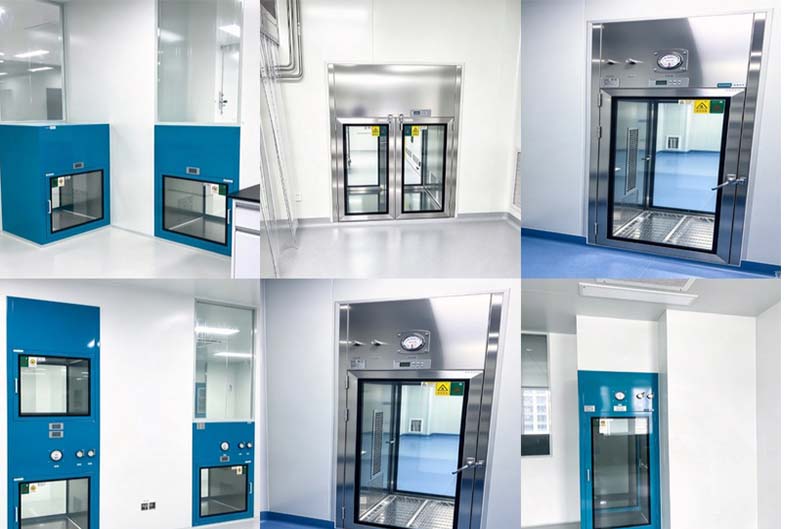
While standard pass-through boxes rely on pressure differentials for isolation, laminar flow pass-through boxes feature an integrated, localized Grade A laminar airflow. They are ideal for high-risk contamination environments, including:
✅ Sterile pharmaceutical manufacturing: Transfer of materials into/out of Grade B zones for sterile APIs, injectables, and biologics.
✅ Biological laboratories: Transfer of samples in cell culture rooms, microbiology labs, and P2/P3 auxiliary areas.
✅ Medical devices: Transfer of materials within sterile manufacturing facilities for implantable consumables.
✅ Semiconductors/Microelectronics: Transfer of wafers and chips within Class 100 or Class 1000 cleanrooms.
Selection Tips: For large items or materials sensitive to direct airflow, custom-sized chambers are available. If sterilization is required, units can be equipped with UV lamps or VHP (vaporized hydrogen peroxide) ports. For applications involving radiopharmaceuticals, a BIBO (Bag-In/Bag-Out) containment configuration can be specified.
III. Regulations and Operations & Maintenance
Routine Operations & Maintenance & Periodic Re-qualification
Validation protocols and reports must comply with: China’s GMP (2010 revision) and its annex on "Sterile Medicinal Products," EU GMP Annex 1, PIC/S guidelines, and the ISO 14644 series of standards for cleanrooms. Validation documentation must be complete and traceable—encompassing URS, risk assessments, full DQ/IQ/OQ/PQ protocols, raw data, deviation reports, change control records, and final validation summary reports—to form a comprehensive Validation Master File, ensuring readiness for unannounced regulatory inspections.
✅ Daily (per shift): Check interlocks, fan operating status, filter pressure differentials, and alarm functions; document any anomalies.
✅ Periodic Testing: Conduct annual PAO leak testing; periodically re-verify cleanliness levels, airflow patterns, and recovery (clean-up) times.
✅ Triggers for Re-validation: Re-validation and assessment are mandatory following filter replacement, major equipment overhauls, relocation or modifications, replacement of chamber seals, significant process changes, or instances where validation results consistently exceed established limits.
✅ Spare Parts Management: Maintain an inventory of HEPA filters (matching the installed models), sealing gaskets, and control components to minimize downtime.
In cleanroom environments, no detail is too small—and validation is the true test of quality. AN offers laminar-flow pass-through boxes, customized validation protocol development, and on-site testing services. Serving sectors including pharmaceuticals, biological laboratories, semiconductors, and medical device manufacturing, AN provides a one-stop solution to assist clients with equipment delivery, validation execution, and the achievement of GMP compliance.
