COMPANY NEWS
Material Transfer Process and Validation Key Points for Sterility Testing Isolators
Sterility testing serves as the final microbiological quality checkpoint prior to the release of a medicinal product. In accordance with General Chapter 1101, "Sterility Test," of the *Chinese Pharmacopoeia*, sterility testing must be conducted either within a localized Grade A unidirectional airflow zone—situated in a Grade B cleanroom environment—or within an isolator system. The entire procedure must strictly adhere to aseptic practices to prevent microbial contamination; furthermore, any contamination control measures implemented must not interfere with the detection of microorganisms potentially present in the test sample.
I. Why the Transfer of Materials In and Out Is a High-Risk Aspect of Isolation Systems
Risks Associated with Material Transfer and Fundamental Principles
During the operation of an isolator, Grade A cleanliness and a controlled pressure differential are maintained within the chamber, while the surrounding support environment typically has a lower cleanliness classification. Each instance of material entering or exiting the isolator creates an "opening" between the sterile internal environment and the external environment. Potential risks introduced by this include:
✅ Microbial bioburden on surfaces: Bacteria, molds, and spores present on the outer packaging of the items to be tested or on the surfaces of equipment/utensils.
✅ Particulate contamination: Fibers or debris shed from packaging materials that enter the chamber along with the items.
✅ Sterilant penetration and residues: Sterilizing agents—such as vaporized hydrogen peroxide (VHP)—used for surface sterilization may permeate breathable packaging and enter the container, potentially inhibiting the detection of low-level microbial contamination and leading to false-negative results.
✅ Compromised seal integrity: Failure of interface seals during docking or transfer processes, which can cause fluctuations in pressure differentials or the ingress of microorganisms.
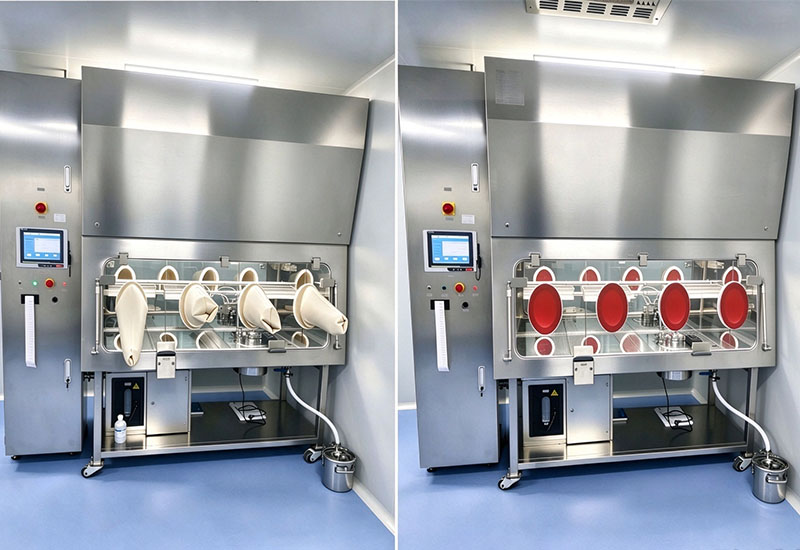
For sterility testing, the use of closed, rigid-wall isolators is the most prevalent approach. These systems offer clearly defined material transfer pathways and verifiable barrier integrity, making them particularly well-suited for quality control (QC) laboratories that are sensitive to false positives and require full traceability.
In accordance with the fundamental requirements set forth in regulations and standards, the transfer of materials into and out of an isolator must adhere to the following basic principles:
1. Prior to being transferred into a bio-decontaminated isolator, all components, materials, and equipment parts must be sterile, already bio-decontaminated, or subjected to bio-decontamination within the transfer system itself;
2. The transfer process must not compromise the environmental control conditions of the isolator, nor should it pose a risk to the safety of operators;
3. Except for the controlled entry of intended items via the transfer system, the ingress of any other objects during operation must be prevented.
4. The transfer interface shall ensure an airtight seal to prevent leakage from the controlled environment into adjacent supporting areas.
5. The transfer system and its associated bio-decontamination procedures shall be developed and qualified, with process parameters that are recordable and traceable.
II. Three Main Methods for Introducing Materials into an Isolator
VHP Pass-through Chamber / Rapid Transfer Port (RTP) / Dedicated Container
Common methods for transferring materials into sterility testing isolators include the use of VHP (vaporized hydrogen peroxide) transfer chambers (surface bio-decontamination chambers), rapid transfer ports (RTPs, or α/β docking systems), and the introduction of materials via specialized containers following off-line sterilization. These methods are not mutually exclusive and are often used in combination within actual system configurations.
Q: Sterilizable Transfer Chamber
A: This is the most common method for transferring items into a sterility testing isolator. Located between the main processing chamber and the external environment, the transfer chamber is a separate, small enclosure equipped with an inner and an outer interlocked door; it is capable of running its own independent bio-decontamination cycle.
Q: Rapid Transfer Port (RTP; α/β Docking System)
A: A Rapid Transfer Port (RTP) utilizes a double-door transfer system. It consists of an "alpha" (α) port—fixed to the isolator—and a mobile "beta" (β) container or bag; both components are independently sealed.
Q: How are items introduced after being sterilized offline?
A: For heat-resistant items, final sterilization can be performed using a double-door sterilizer (such as a moist-heat sterilizer), followed by transfer into the isolator via a specialized sealed container or an RTP (Rapid Transfer Port) container. For heat-sensitive items, offline sterilization methods—such as irradiation or ethylene oxide sterilization—may be used, with the items then introduced in sterile packaging.
III. Material Removal from the Containment Area: Controlled Removal of Waste and Positive Controls
Precautions for Removing Materials from the Containment Area
The transfer of materials out of an isolator is just as critical as their entry. In the context of sterility testing—which involves positive control microbial suspensions, spent culture media, filter membranes, and waste contaminated with microorganisms—it is essential to both prevent the escape of microorganisms from the isolator into the external environment and avoid the reverse contamination of the sterile interior during the removal process.
Removal of Routine Waste
Solid waste (such as discarded packaging, filter membranes, and gloves) and liquid waste should be collected separately.
Waste should preferably be removed via a dedicated waste transfer port or a sealed BetaBag to maintain the integrity of the isolator barrier.
The route for waste removal should ideally be separate from the entry route to prevent the crossing of material flows.
Once removed, waste must be disposed of in accordance with relevant regulations for laboratory biosafety and medical waste.
Special Controls for Positive Control Materials
Positive control testing requires the inoculation of a quantitative control microorganism (with an inoculum size of less than 100 CFU); the positive control microbial suspension is considered a biohazardous material. The following measures should be considered:
✅Positive control procedures should be performed in a dedicated positive control chamber or a separate workstation, physically segregated from the workstation used for testing the product under examination, to prevent cross-contamination.
✅Containers holding the positive control microbial suspension should be transferred into and out of the area via a Rapid Transfer Port (RTP) or a specialized sealed container system to avoid open exposure.
✅Upon completion of the positive control testing, all associated waste must be sealed within the chamber before being removed through a designated, separate channel.
✅Environmental monitoring, cleaning and disinfection, and re-verification for positive control areas should be incorporated into SOP management.
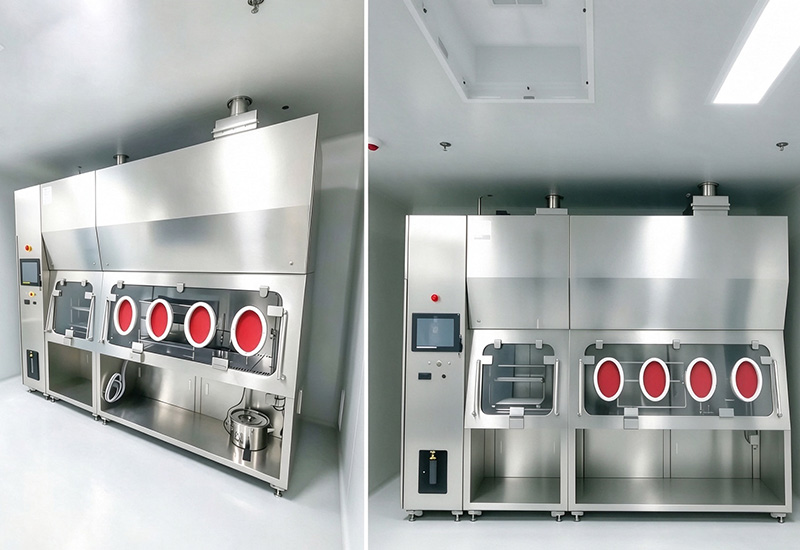
Maintaining Containment Barriers During Material Removal
Whether using a transfer chamber or a Rapid Transfer Port (RTP), the same interlocking and sealing principles applied during material entry must be followed during removal: the inner door must be closed and its seal verified before the outer door is opened. Opening both the inner and outer doors simultaneously—which would create a direct airflow path—is strictly prohibited. In the case of positive-pressure isolators, the removal pathway must ensure that airflow moves in an orderly fashion—from the Grade A critical zone into the transfer chamber, and subsequently into the external environment—to prevent the backflow of external air.
IV. Key Control Points in the Material Inbound and Outbound Process
Loading, Sealing, and Sterilization
Loading Methods and Sterilization "Dead Zones"
Gaseous sterilizing agents, such as VHP (Vaporized Hydrogen Peroxide), only act upon surfaces with which they come into direct contact. Areas that are obstructed, pressed against one another, or stacked—referred to as "shadow zones"—pose a risk of incomplete decontamination. Therefore:
Items should be arranged in a dispersed manner on racks, ensuring sufficient space between them for gas circulation.
Avoid having packaging in direct contact with other items, and prevent instruments from being nested too deeply.
The loading configuration used in routine operations must be identical to that employed during the validation of the sterilization cycle; validation must encompass both maximum-load and "worst-case" loading conditions.
Package Integrity and Sterilant Penetration (Prevention of False Negatives)
Pharmacopeia chapter 9206 identifies "package integrity verification" as a critical aspect of isolator system applications. While sterilizing gases typically cannot penetrate well-sealed containers—such as screw-capped tubes, stoppered glass vials, or ampoules—they may permeate certain gas-permeable packaging materials (e.g., Tyvek, single-layer plastic films, or paper-based packaging). This penetration can inhibit the growth of microorganisms within the container, leading to false-negative results. Appropriate control measures include:
Verifying the resistance of packaging materials to sterilant penetration through chemical challenge tests and microbial recovery studies.
Confirming that items subjected to a surface sterilization cycle still meet the recovery test requirements for the relevant microbial species.
For materials susceptible to penetration, utilizing packaging that is resistant to sterilant ingress, or placing the items into sterile, hermetically sealed containers—while ensuring that such measures do not inadvertently create new "dead zones" (areas inaccessible to the sterilant).
Reducing the risk of penetration—if necessary—by lowering the sterilant concentration or shortening the surface sterilization cycle; any such modified cycle must be thoroughly validated.
Analysis of Sterilant Residues
Following the completion of a sterilization cycle and prior to the commencement of any testing, it must be verified that the concentration of residual sterilizing gas within the isolator is below an acceptable threshold. In practice, the following points should be considered:
The end of the aeration (ventilation) phase should not be determined solely by a fixed duration; instead, it should be assessed based on a combination of multi-point concentration monitoring and surface residue testing.
Absorbent materials—such as rubber, plastics, and thermal insulation—may slowly release previously adsorbed hydrogen peroxide, potentially leading to a rebound in concentration after the aeration phase has concluded.
Residue limits should distinguish between occupational exposure limits for personnel and residue limits for product-contact surfaces. Stricter criteria must be applied for sensitive materials, such as biological products and protein-based preparations.
Seal Integrity and Interlock Effectiveness
Seals for the inner and outer doors of the transfer chamber, RTP α/β ports, glove/sleeve assemblies, and all wall-penetration interfaces must be inspected periodically to ensure their integrity.
The door interlock mechanism must ensure that the inner and outer doors cannot be opened simultaneously.
A pressure-hold test of the chamber should ideally be performed prior to each decontamination cycle; furthermore, the integrity (leak rate) of the isolator should be verified on a routine basis.
Process Documentation and Traceability
For each transfer batch, a traceable record shall be generated, including at minimum: material name and quantity, loading configuration, transfer method, cycle number, critical process parameters (sterilant concentration, temperature, humidity, exposure time, and pressure), results of residual testing, operator identification, and timestamps. The control system should feature audit trail and electronic record-keeping capabilities to ensure data reliability.
V. Common Deviations and Risk Warnings
Biological decontamination, residual risks, sealing and interlocking, process traceability
Based on findings from unannounced inspections and industry practices, typical deficiencies in the handling of materials entering or exiting a controlled environment include:
1. Discrepancies between actual loading and validated configurations: Items are stacked in a way that obstructs gas diffusion during routine operations, whereas the validated loading pattern is less dense—leading to incomplete sterilization during the actual cycle.
2. Simultaneous opening of both doors: Failure of the pass-through chamber interlock system or procedural violations result in a direct airflow path between the interior and exterior, compromising the contamination barrier.
3. Relying solely on a timer to assess residual levels: Testing begins before verifying that hydrogen peroxide residues in the space or on surfaces have dissipated, creating a risk of "false negatives" where residual sterilant inhibits microbial growth.
4. Lack of assessment for packaging permeability: Failure to conduct challenge tests on gas-permeable packaging, allowing the sterilant to penetrate into the samples or filter membranes.
5. Failure to replace aged seals: Deteriorated seals on Rapid Transfer Ports (RTPs) or pass-through doors allow for microbial ingress at these interfaces.
6. Lack of segregation for positive control materials: Positive bacterial suspensions and test samples are handled at the same workstation and move along the same path, posing a risk of cross-contamination.
7. Incomplete documentation: There is a lack of traceable records for the transfer of batch parameters, residual test results, and confirmation of process interfaces, which fails to meet data integrity requirements.
In the event of a positive biological indicator result, failure to meet concentration specifications, excessive condensation, or an environmental monitoring excursion, a formal deviation investigation must be initiated. This process should include a review of operational procedures and, where necessary, the use of simulation tests to replicate the conditions that led to the failure. A surface shall not be deemed sterile based solely on a visual inspection.
The ability of an isolator to provide a reliable Grade A barrier for sterility testing depends not only on the cleanliness and airtight integrity of the chamber itself, but also—and perhaps more critically—on the level of control maintained during each "open—decontaminate—seal—transfer" cycle for materials entering or exiting the system. A compliant and verifiable material transfer pathway must ensure that: surfaces are effectively decontaminated prior to entry; risks associated with packaging and potential residues are validated; interface sealing and interlocking mechanisms are robust; the entire process is fully traceable; and the removal of waste or positive-test materials is conducted in an orderly manner without compromising the integrity of the barrier.
